WikiGame
One start article, one target, and only the blue links in between. Everyone gets the same pair each day, and a bot solves it first so you have a number to beat.
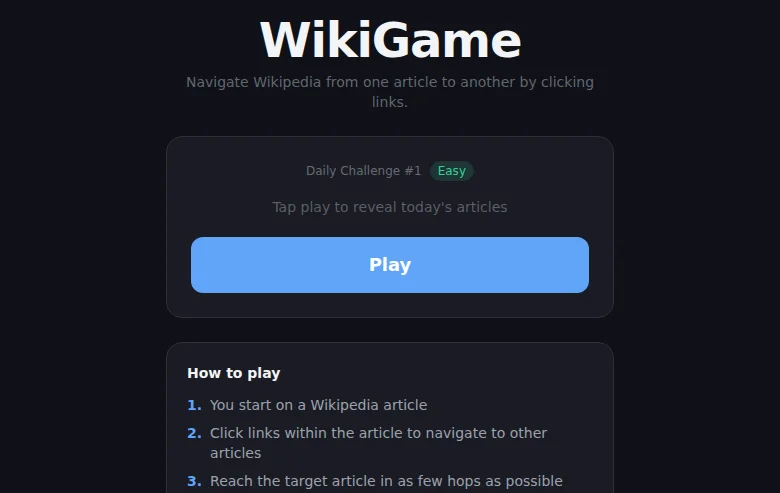
The Wikipedia Game is the old browser dare: land on some article, reach another one, click only the links inside the pages. It has always been played on the honour system in a browser tab, which makes it easy to cheat and impossible to compare. WikiGame puts it on a schedule instead. Everyone playing on a given day gets the same start and the same target, the rules are enforced by the app rather than by you, and the run ends with a score you can hold next to someone else's.
The day's pair
Challenge #1 was 19 April 2026 and the number goes up by one at local midnight. The pair comes out of a hand-written pool of 1,822 start/end pairs, each labelled easy, medium or hard, dealt in order and wrapping after about five years. The start is usually something obscure and the target something famous, so the difficulty is real but the goal is recognisable: Isomorphism-closed subcategory to Boeing 747 was an easy one. Neither title is shown before you commit. The card on the home screen gives you the number and the difficulty, and nothing else until you press play.
The bot that sets par
Between pressing play and starting the clock there is a ready screen showing the two articles, and while you read them a solver works the same puzzle in the background. It is a trimmed port of the walker from the Wikipedia Game Solver: at each page it scores up to twenty outbound links by TF-IDF cosine similarity between their intros and the target's intro, then jumps to the best unvisited one, with twenty hops as the ceiling. It also pulls the target's backlinks up front, so any link that sits one hop from the goal is taken immediately. When the top scores bunch up, or it starts circling variants of the same title, it penalises candidates that share words with where it has just been and reaches for a broader article to break out.
Whatever it lands on becomes your par: its hop count, plus a time budget of twenty-five seconds per hop. On the pair above it needed eighteen hops, which set a target of 7m 30s. You can begin before it finishes, and the path it found is kept so you can watch it later without paying for the search twice.
What the app will not let you do
- Search: the article HTML comes from Wikipedia's REST API and every anchor has its href taken away before it renders, so a click is a move in the game rather than a page load. Citations, category and portal pages, and outbound links are dead.
- Click through from the target: the target preview renders the whole goal article, image and infobox included, with every link unwrapped into plain text. You can read it for clues, but you cannot ride it home.
- Fly blind: hovering a link, or long-pressing it on a phone, opens a popover with the summary of where it goes, so a guess costs you a moment instead of a hop.
- Lose your place: the running game is held in session storage, so a reload puts you back on the article you were reading, and the day's result and the bot's path stay in local storage after it ends.
Finishing produces the path you actually took, with any article you doubled back to marked in red, and a button that lays the bot's route out beside it. The shareable version is deliberately thin: challenge number, hops, time, and a row of squares standing in for the articles. Sending someone your result cannot spoil their run. Giving up records the attempt too, which is the honest thing to do with a puzzle that some days beats you.
Off the schedule
Two other modes reuse the same machinery. Random pulls genuine random articles from the MediaWiki API and throws back anything unplayable, lists, indexes, disambiguation pages, bare years, and stubs under two kilobytes, so the pair it hands you has enough links to be winnable. Custom takes any two titles through an autocomplete backed by Wikipedia's search and checks both exist before the clock starts. The bot solves those pairs too.
Built with
React · TypeScript · Vite · Tailwind, in four themes. Both Wikipedia interfaces are called straight from the browser, the Action API for links, backlinks and intro extracts, the REST API for article HTML and summaries, so there is no key, no backend, and nothing to host beyond static files.